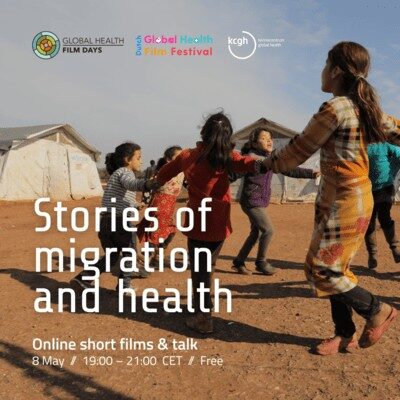
On 8 May 2025, more than 75 participants participated online in Stories of Migration & Health, an evening of short films and expert reflection organised by the Dutch Global Health Film Festival and the Global Health Film Days in Copenhagen.
The programme featured three short films that explored different stages of the migration journey. As the Crow Flies offered a personal reflection on growing up between cultures in Denmark, exploring identity, belonging and the long-term emotional impact of migration. The Swedish Speaking Migrants of Paris told the story of young men who, having built a life in Sweden, were forced to start over in France after losing their residency status. Finally, Game Over gave a raw picture of the lives of young Afghan refugees in Istanbul, who lived in secret and risked everything to enter Europe.
The panel discussion that followed, brilliantly moderated by Megan Milota (UMC Utrecht), connected these stories with real-world experiences in health care, community support and migration policy. The panel included Sara Sahba (EKANN), Hussain Jafari (Red Cross Netherlands) and Maria Marti Castaner (University of Copenhagen).
The panel explored how migration affects health and well-being, not only during the journey, but also long after arrival. Mental health emerged as a recurring theme, described as an ongoing struggle shaped by prolonged uncertainty, instability and the challenges of constantly starting over. Hussain Jafari described this as “a mental crisis, not at one moment, but throughout the journey, and often long after it has ended.”
The talk highlighted how the pressure to ‘prove your worth’ in a new society often weighs heavily on migrants, especially families and mothers. Maria Marti Castaner outlined how insecure housing, frequent moves and unsafe environments undermine well-being, making it difficult for families to build stability or meet their children's basic needs.
At the same time, Sara Sahba emphasised that despite these barriers, parents still continue to prioritise their children's health and future. Based on research with families in Dutch asylum seekers' centres, she shared how parents consistently express a desire for their children to receive the best possible care, but often lack the resources or mental space to stand up for themselves. She also reflected on the long-term impact of growing up between different cultures, and how feelings of belonging and identity continue to shape lives long after being resettled.
Throughout the discussion, speakers stressed the importance of community-based support, from volunteer-led workshops such as the Red Cross Life Skills programme, to small actions that create safe spaces for connection and learning. They concluded by encouraging participants to continue to listen to lived experiences and recognise the resilience of people who, despite repeated setbacks, continue to rebuild their lives.
The recording of the panel discussion can now be viewed online: https://www.youtube.com/watch?v=9Qs13_rXc-w
The film The Swedish Speaking Migrants of Paris can be viewed online here: https://www.youtube.com/watch?v=dXuGaiXbvXE
Thank you to everyone who participated with us. Stay connected for future events through the Dutch Global Health Film Festival, Global Health Knowledge Centre and the Global Health Film Days in Copenhagen.
 Dutch
Dutch English