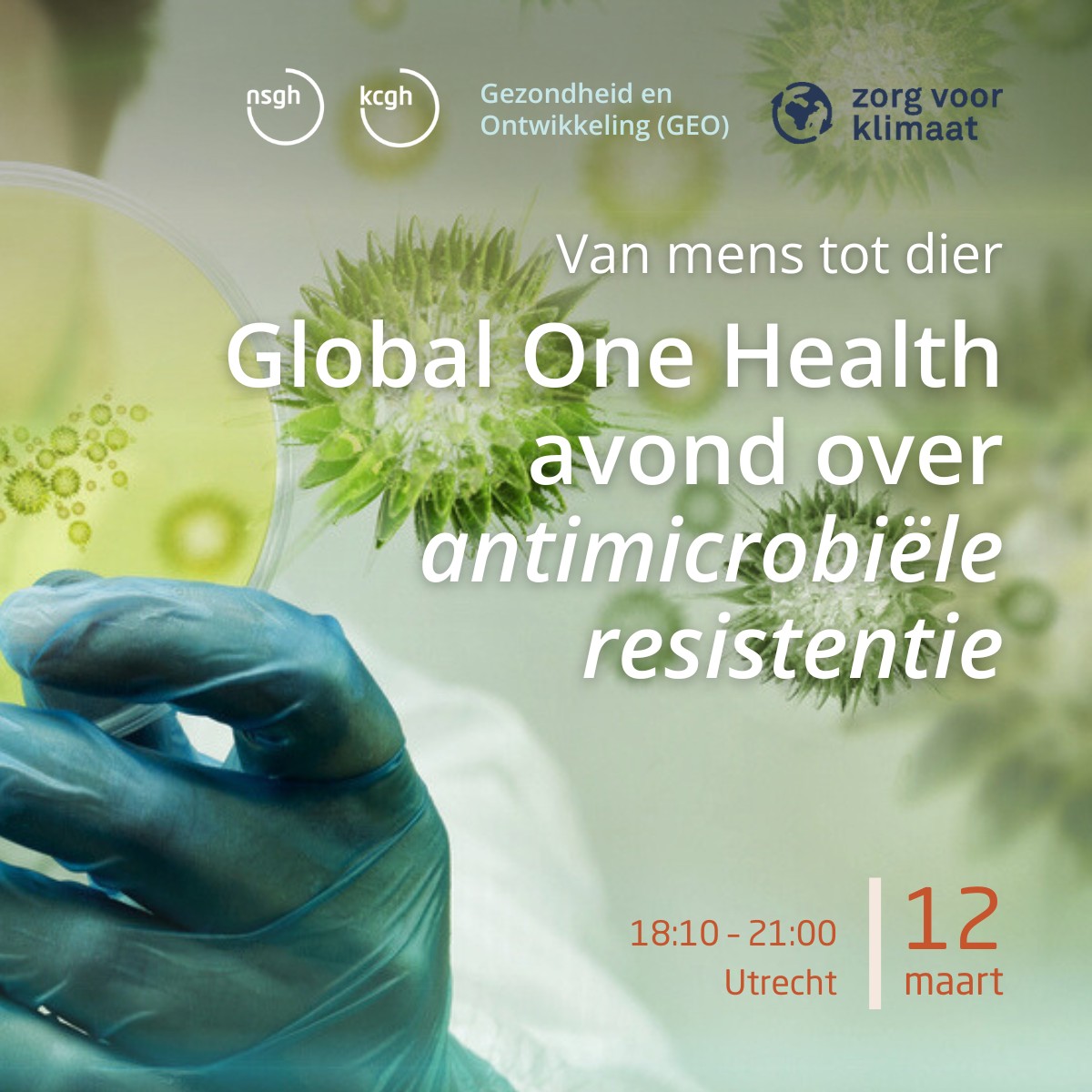
Bacteria that no longer respond to antibiotics: a creeping danger costing lives worldwide. The NSGH working groups Zorg voor Klimaat and GEO invite you to an evening in which we will examine the impact of antimicrobial resistance (AMR) from a global perspective and look for solutions.
According to a large-scale global analysis published in The Lancet, bacterial resistance was directly responsible for 1.27 million deaths in 2019 and contributed to another 4.95 million deaths worldwide.¹
AMR affects countries in all regions and income groups, and its effects are exacerbated by poverty and inequality. Misuse and overuse of antimicrobials in humans, animals and in agriculture are major causes of this problem.
Yet during this evening, we do not want to dwell only on the threat, but rather on action perspectives and hopeful initiatives from the field.
Joining us will be a veterinarian who will share her experiences in reducing antibiotic use in animal husbandry, including in India; an employee of Médecins Sans Frontières (MSF) who will talk about the consequences of AMR when treating war-wounded in conflict areas such as Ukraine; and an interactive AMR pub quiz to test your knowledge and learn.
This evening is aimed at anyone interested in global and sustainable health. AMR requires collaboration across sectors – from humans to animals, from agriculture to the environment.
1. Antimicrobial Resistance Collaborators. (2022). Global burden of bacterial antimicrobial resistance in 2019: a systematic analysis. The Lancet; 399(10325): P629-655. DOI: https://doi.org/10.1016/S0140-6736(21)02724-0
Programme
| 18:10 | Welcome with soup, sandwich and salad |
| 18:40 | MSF's approach to AMR Mohammed Khalife |
| 19:15 | Natural lifestocking: A strategy for improving livestock health as an integrated part of AMR reduction and agro-ecology Katrien van ‘t Hooft |
| 19:45 | Break |
| 20:00 | AMR Pub Quiz |
| 20:40 | Review and closing |
Speakers
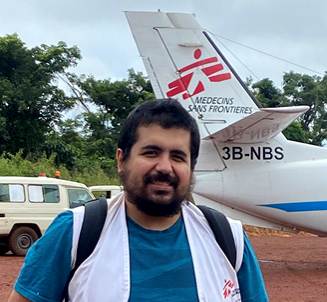
Mohamad Khalife, MD is an internist and infectiologist with a focus on antimicrobial resistance. He works for Médecins Sans Frontières (MSF) as a member of the Manson Unit in London, where he supports AMR policy and antibiotic stewardship in humanitarian contexts worldwide. He combines hands-on infection care with research, monitoring and awareness-raising around AMR.
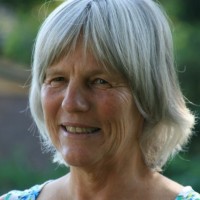
Dr Katrien van ’t Hooft is a veterinarian and founder of Dutch Farm Experience, with more than 25 years of experience in sustainable dairy farming worldwide. She is director of the Foundation for Natural Livestock Farming (NLF), an international collaboration including India, Ethiopia and Uganda. The NLF approach shows positive effects on animal health, antibiotic reduction, food safety and the environment.
 Dutch
Dutch English