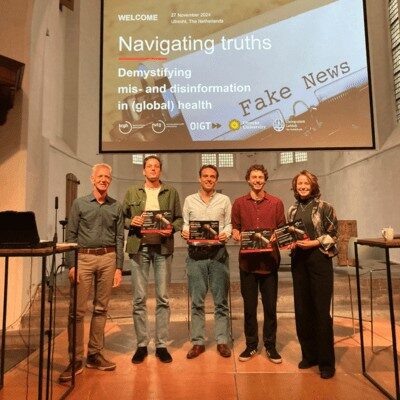
In 2024, we received a record number of high-quality entries, 36 in total, demonstrating the breadth and depth of research in global health by recent graduates. The winners, selected by an expert jury, each brought new perspectives to urgent global health challenges. Now, almost a year later, we asked them: What did winning the award mean to you, and what came next?
Tom Jacobs
PhD thesis (Global Child Health): Accelerating access to optimal anti-infective treatment for children living with HIV
“Winning the award was a real honour. It gave me valuable recognition and the opportunity to connect with others working in the field of global child health and access to medicines,” says Tom Jacobs, whose doctoral research focused on improving HIV treatment options for children in low-income countries.
Tom used the prize money to extend a research visit to Uganda, where he reconnected with colleagues and explored new opportunities for collaboration. Since receiving the prize, he has become a co-applicant in two major clinical trials on paediatric HIV treatment, joined the WHO Working Group on Paediatric Antiretroviral Therapy, and taken on a supervisory role for three PhD students: two in the Netherlands and one in Zimbabwe.
Lennart Maljaars
Doctoral research: Surgical care and innovation for vesicovaginal fistulas
For Lennart Maljaars, the award offered recognition and a valuable opportunity to expand his network: “I was very pleased to receive the award and to connect with a broader global health community, beyond the obstetrics and gynaecology departments where I conducted my research.”
Although he has not yet spent the prize money, Lennart plans to join a fistula surgeon in the field to gain practical experience that will complement his academic and clinical career. In the meantime, he is preparing a publication based on a consensus project he chaired, in collaboration with a fistula expert. “We are about to publish an article on the outcomes of obstetric urinary tract pelvic floor fistulas, supported by the International Urogynaecology Association (IUGA) and the International Continence Society (ICS). I am very proud of this project and hope to continue researching this topic throughout my career.”
Lara Schmale-Hüsemann
Bachelor's thesis: Analysis of health equity in the Africa CDC's strategy for non-communicable diseases
“Winning the award was truly a recognition – not only for my individual work and that of the other award winners, but also for the diversity of research areas within global health care,” says Lara Schmale-Hüsemann. Her thesis critically examined how principles of equity are integrated into strategies for non-communicable diseases by the Africa CDC. “I was pleased to see that health equity has not only been mainstreamed, but is also considered an important topic in its own right.”
Since receiving the award, Lara has completed an internship at the German development organisation GIZ, where she advised on Germany's approach to feminist and equitable development policy. Here, she was able to integrate many insights from her thesis and actively apply health lenses to the relevant policy measures and processes. She plans to use the prize money to support her research during her master's degree, preferably with a focus on participant-based or implementation research.
Robert Dasović
Master's thesis: Unheard voices: Navigating the life course of people experiencing homelessness in a fragmented healthcare system
For Robert Dasović, the KCGH Thesis Award served as a great motivation to continue. “It has been a tremendous encouragement to further explore this line of research,” he says. His thesis examined the lived experiences of homeless people in Rotterdam, using life story interviews and life map methods to investigate how trauma, social exclusion and systemic neglect contribute to homelessness.
Robert used the prize money in a way that was true to the ethos of his research, sharing meals with his respondents to thank them for sharing their stories with him. Since then, he has expanded the project into a realistic review of international literature on health outcomes among people who are homeless. “I analyse which contexts and mechanisms influence different health outcomes. The goal is to generate actionable insights for the development of care and policy – and this deeper synthesis is helping to shape my future research direction.”
A springboard for early-stage researchers
These reflections show that the KCGH Thesis & PhD Prize is more than a one-off recognition – it serves as a springboard. Whether it is funding fieldwork, increasing visibility, facilitating new connections, or simply providing motivation to continue, the award supports the next generation of researchers and professionals working to advance global health. We are proud to follow the journeys of our 2024 winners and look forward to meeting this year's group.
 Dutch
Dutch English